 ZhongQi Growth
ZhongQi Growth
ZhongQi Growth
Choosing among China Tie Down Straps manufacturers requires more than comparing prices. Product reliability depends on webbing strength, stitching quality, hardware durability, testing, and traceability. A bright catalog photograph proves very little.
Industry data supports careful supplier screening. Grand View Research reports continuing growth in the global cargo handling equipment market, driven by logistics, warehousing, and e-commerce expansion. The Business Research Company also identifies transportation activity and supply-chain investment as major demand factors. These reports do not rank individual factories. They show why production capacity alone cannot define quality.
The International Road Transport Union emphasizes that properly secured cargo reduces movement, damage, and roadside risk. Cargo-securement specialist Gary A. Smith states, “A restraint is only effective when its working load limit matches the cargo and the application.” That principle should guide every manufacturer interview.
Ask for working load limit records, abrasion tests, corrosion checks, batch numbers, and independent inspection reports. Request samples before signing a large order. Inspect the hook profile, ratchet action, label clarity, and seam consistency by hand.
A strong factory welcomes uncomfortable questions.
Look for ISO-based quality systems, documented corrective actions, and experienced export teams. Confirm whether test reports match the exact model, not a similar product. This detail is often missed.
No supplier ranking is perfect. Even reputable manufacturers can show inconsistent batches. Buyer experience, factory audits, and clear specifications must work together. The best China Tie Down Straps manufacturer is not always the cheapest. It is the supplier that can repeatedly prove performance, communicate honestly, and improve when defects appear.
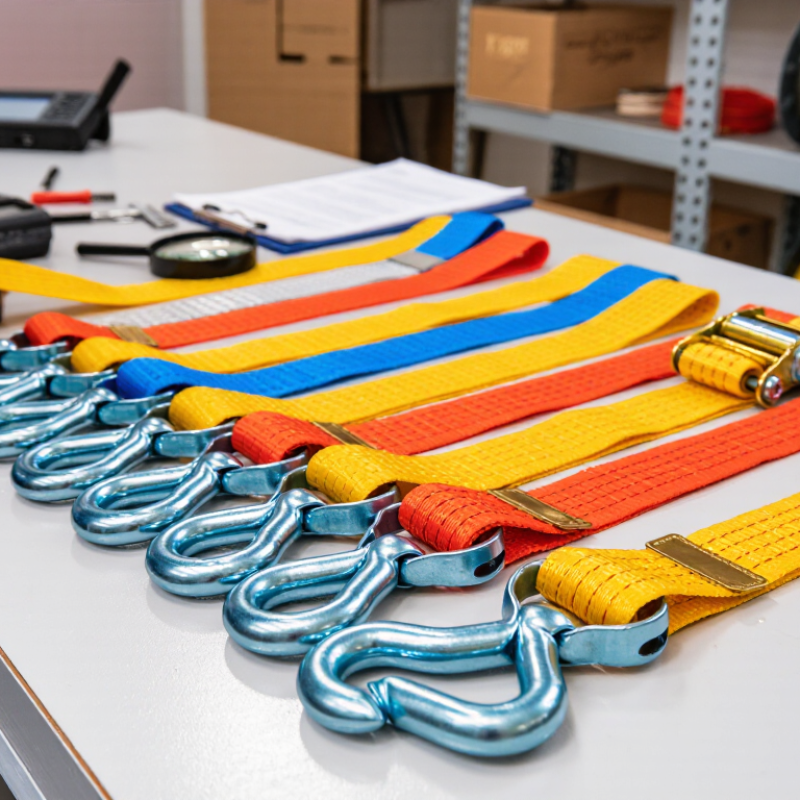
A reliable China tie-down straps manufacturer starts with traceable materials, not attractive catalog photos. Ask for webbing specifications, batch numbers, and supplier inspection records. Polyester webbing should show stable width, stitching density, and resistance to abrasion after repeated loading. Small details matter.
The U.S. Bureau of Labor Statistics reported 1,942 fatal workplace injuries from transportation incidents in 2023. That represented 38.2% of all occupational fatalities. The figure shows why cargo restraint deserves engineering attention. The Federal Motor Carrier Safety Administration requires a tie-down system’s aggregate working load limit to reach at least half the cargo weight. A dependable manufacturer should explain this calculation clearly. It should also provide test results from independent laboratories.
Look for factories with calibrated tensile machines, controlled stitching lines, and documented final inspections. Request samples before placing a large order. Bend the strap around a realistic edge protector, inspect the seams, and compare measured length with the specification. EN 12195-2 testing can support product evaluation, but certificates alone prove little without matching batch records. I have seen polished documents hide inconsistent stitching. That is easy to overlook.
A useful supplier shares corrective-action reports when defects appear. It should accept uncomfortable questions about failure rates, dye migration, and storage aging. Claims of “strongest” are less valuable than repeatable test data. Price still matters, but unstable quality becomes expensive after one missed inspection. Sometimes the cheapest quotation is only the cheapest assumption.
| Evaluation Dimension | What a Reliable Manufacturer Should Provide | Practical Data or Benchmark | Documents or Evidence to Request | Warning Signs | Importance |
|---|---|---|---|---|---|
| Webbing Material | Clearly identified polyester webbing with consistent width, thickness, color, stitching quality, and resistance to abrasion. | Polyester is widely used because it has low stretch compared with many other synthetic fibers and performs well in common outdoor and cargo-securing applications. | Material specification, webbing technical data sheet, incoming-material inspection records, and sample measurements. | Unspecified fiber type, mixed materials, irregular weaving, or large differences between samples. | High |
| Available Webbing Widths | Production capability for commonly used sizes and the ability to maintain dimensional tolerances. | Common tie-down webbing widths include approximately 25 mm, 35 mm, 50 mm, 75 mm, and 100 mm, depending on the application and assembly design. | Width and thickness tolerance table, production photographs, and sample inspection report. | Only nominal width is stated; actual measurements are not controlled or recorded. | Medium |
| Rated Capacity and WLL | Working Load Limit (WLL) is stated separately from breaking strength and is calculated for the complete assembly, not only the webbing. | WLL depends on webbing, end fittings, stitching, tensioning device, configuration, and safety factors. It must not be estimated from webbing width alone. | Product label, technical drawing, assembly test report, and traceable WLL calculation or certification. | Breaking strength is advertised as the usable load, or WLL is missing from the product label. | Required |
| Compliance with Standards | Products are designed and tested against the standard required by the destination market and application. | EN 12195-2 covers web lashings for securing loads on road vehicles in Europe. Other markets may require different regulations, labeling, or test methods. | Current test reports showing product identification, test method, sample configuration, results, and laboratory details. | A generic certificate is provided without matching the exact strap width, hardware, stitching, or model. | Required |
| Laboratory Testing | Testing covers the complete tie-down assembly, including webbing, hooks, ratchet, stitching, and adjustment mechanism. | Useful tests may include tensile strength, cyclic loading, abrasion, corrosion resistance of metal parts, and environmental conditioning where relevant. | Laboratory report with test date, sample quantity, test conditions, failure mode, and pass/fail conclusion. | Only internal visual inspection is available, or test results contain no sample and configuration details. | High |
| Ratchet and Hardware Quality | Hooks, buckles, ratchets, and fittings are compatible with the specified load and protected against premature deformation or corrosion. | Hardware capacity must be evaluated as part of the complete assembly. A stronger webbing cannot compensate for an undersized or weak fitting. | Hardware material specification, dimensional drawings, surface-treatment details, and assembly-strength results. | Sharp edges, rough plating, excessive play, incomplete engagement, or hardware rated below the webbing assembly. | High |
| Stitching and Joint Construction | Load-bearing areas use consistent stitch patterns, suitable thread, reinforced stress points, and controlled seam dimensions. | Stitching strength is affected by thread type, stitch density, seam design, overlap length, and the distance from the webbing edge. | Stitching specification, approved samples, seam inspection standard, and destructive test records. | Loose threads, skipped stitches, short overlaps, uneven bar-tacks, or visible needle damage. | Required |
| Environmental Performance | Material selection and finishing are matched to temperature, moisture, sunlight, chemicals, and abrasion expected in service. | Polyester generally offers good resistance to moisture and many common conditions, but ultraviolet exposure, chemicals, sharp edges, and repeated abrasion can reduce service life. | Environmental test data, storage instructions, chemical-resistance guidance, and service limitations. | Claims of being universally weatherproof or chemical-proof without defined test conditions. | High |
| Quality Management | Documented inspection procedures are used for raw materials, in-process production, final assembly, packaging, and shipment release. | A traceable quality system should connect each shipment to production records, inspection results, and corrective-action history. | Quality manual, inspection checklist, batch records, calibration records, and corrective-action procedure. | Quality depends only on final visual inspection or there is no batch-level traceability. | High |
| Factory Traceability | Each product batch can be traced to material lots, production date, operators or equipment, and inspection results. | Traceability should cover the webbing, metal hardware, stitching process, test samples, carton labels, and shipment records. | Batch-code format, sample labels, production traveler, and recall or complaint-handling records. | No lot number, no production record, or inability to identify the source of a defective shipment. | High |
| Sample Consistency | Pre-production samples, approval samples, and mass-production goods remain consistent in dimensions, color, hardware, and performance. | Compare multiple samples from different production batches rather than approving only one hand-finished sample. | Golden sample, approval record, batch comparison report, and pre-shipment inspection results. | Mass production uses different webbing, hardware, labels, or stitching from the approved sample. | High |
| Customization Capability | Can adjust length, webbing width, hook style, ratchet type, label, packaging, and color without changing unapproved components. | Any change to webbing, fittings, stitching, or configuration should trigger a new technical review and, when necessary, re-testing. | Engineering change procedure, technical drawings, prototype approval form, and revised test documentation. | Substitutions are made without customer approval or without reviewing their effect on WLL. | Medium |
| Packaging and Product Labels | Labels are durable, readable, securely attached, and contain the information required for safe use and market compliance. | Typical information includes WLL, length, webbing material, manufacturer or traceability code, warnings, and applicable standard references. | Artwork approval, label durability test, packaging specification, and carton drop or transport test where applicable. | Missing WLL, unreadable safety information, overstated capacity, or labels that do not match the tested product. | Required |
| Pre-Shipment Inspection | Finished goods are checked before loading, with defects classified and shipment results recorded. | Inspection should cover quantity, dimensions, appearance, labeling, function of the ratchet, stitching, packaging, and agreed performance checks. | Inspection plan, sampling level, defect classification, inspection photos, and signed final report. | Shipment is released without documented inspection or without checking the complete assembly. | High |
| Lead Time and Capacity | Provides realistic production capacity, material planning, and a clear schedule for sampling and mass production. | Lead time varies by customization, order quantity, material availability, testing, and packaging requirements; it should be confirmed in writing for each order. | Production schedule, capacity statement, material lead-time plan, and on-time delivery records. | Unusually short promises without material or testing plans, followed by repeated delivery delays. | Medium |
| After-Sales Support | Provides usage instructions, complaint investigation, corrective action, replacement policy, and technical communication after delivery. | A reliable supplier should be able to identify the affected batch and provide a documented response to quality claims. | Warranty terms, complaint procedure, corrective-action report template, and product-use instructions. | No written warranty, no technical contact, or refusal to investigate batch-related defects. | High |
| Overall Supplier Qualification | Selection is based on verified product performance, manufacturing controls, compliance, communication, and total cost rather than price alone. | Use a weighted scorecard and require corrective action for any failed safety or compliance item before approval. | Completed supplier audit, approved-vendor checklist, test reports, sample approval, and signed technical specification. | Lowest-price selection with no independent test evidence, no traceability, and no agreed specification. | Required |
Polyester usually provides low stretch, abrasion resistance, and stable performance in moisture. Ask for yarn details, width, breaking strength, and elongation results.
The label should show lashing capacity and standard hand-force performance. It should also include traceable lot information. Clear labels matter.
Use bright light and examine every bar-tack. Watch for uneven stitches, loose threads, damaged seams, and sharp hook edges. Inspect the seams.
Request recent batch reports, not only a general certificate. Useful records cover breaking strength, cyclic loading, abrasion, and corrosion resistance. Independent testing is stronger evidence.
Ask for current loom numbers, sewing lines, testing stations, production records, and monthly output. Confirm typical lead times during busy periods. Capacity means repeatability.
Discuss width, thickness, hook style, buckle strength, labels, packaging, and color matching. Request samples before bulk production. Test samples under realistic loading conditions.
Quality checks should cover incoming materials, production, and finished goods. Ask for inspection records, lot numbers, size tolerances, and stitching controls. Consistent records matter.
No. A strap may look clean but hide damage near a seam. I once trusted the surface too much. Physical inspection still matters.
Choosing a reliable China Tie Down Straps manufacturer requires more than comparing prices. Start by assessing the company’s experience, production capabilities, and reputation for consistent quality. Examine the materials used, such as webbing strength, stitching durability, hooks, buckles, and protective coatings, while confirming that products are designed and tested for safe, dependable performance. Buyers should also verify relevant certifications, load ratings, inspection records, and testing procedures that match their intended application and market requirements.
A thorough comparison should include factory capacity, equipment, customization options, sample approval processes, and quality-control systems from raw materials through final packaging. Pricing should be evaluated alongside product consistency, lead times, communication efficiency, and after-sales support rather than treated as the only deciding factor. A trustworthy manufacturer should provide clear technical information, respond promptly, handle customized requirements professionally, and maintain stable long-term cooperation. By reviewing these factors systematically, buyers can select a capable supplier that offers dependable Tie Down Straps and reduces risks throughout the purchasing process.
